Chief AI Officer: The Decision That’ll Shape Your Whole AI Strategy
Here’s a conversation happening in boardrooms right now that nobody’s really talking about openly – but it’s one every serious company needs to figure out before they plan next year’s budget.
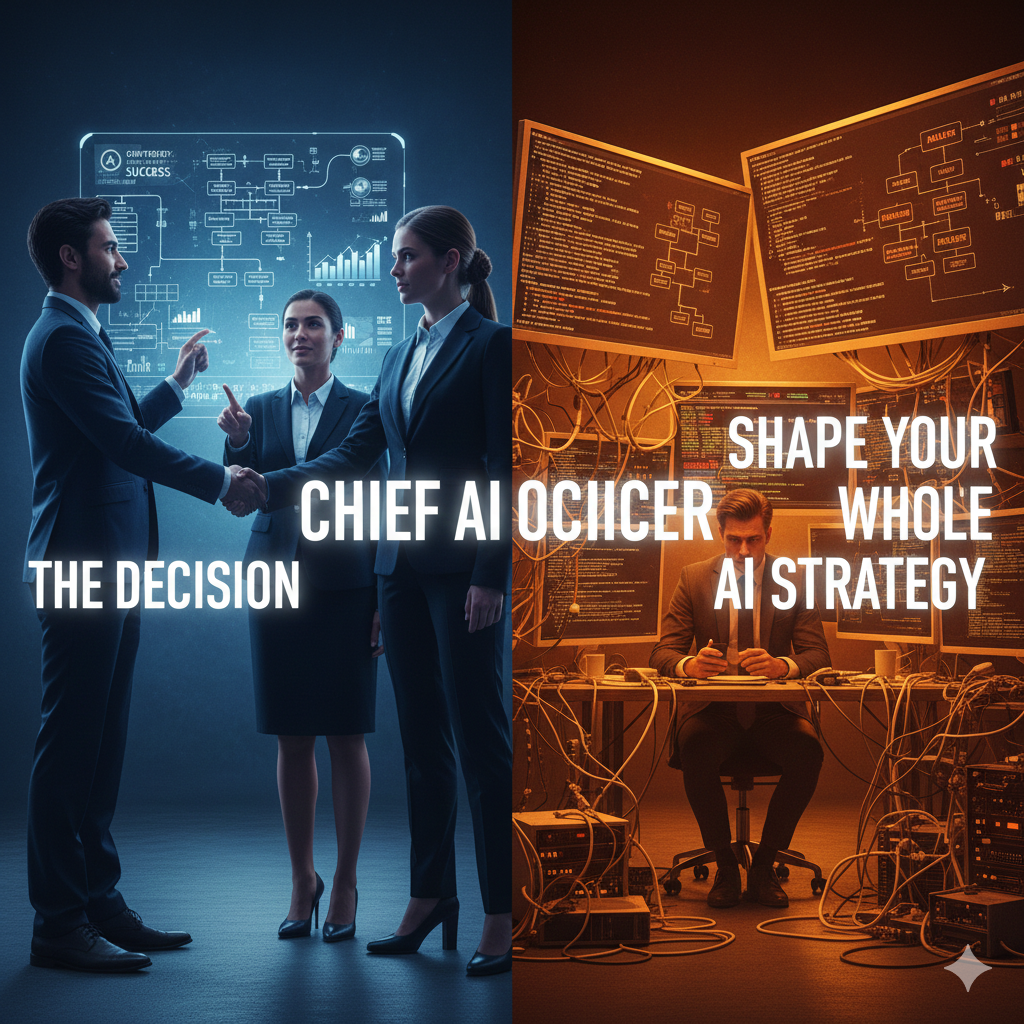
The race to build AI into how your business actually operates? That’s not optional anymore. It’s the defining competitive thing of this decade. And sitting right in the middle of it is one high-stakes hiring decision: do you bring in a Chief Artificial Intelligence Officer as a permanent executive on your team, or do you engage one through consulting?
This isn’t just about budget, though that obviously matters. It’s about whether your organization is actually ready, how mature your AI strategy is, and where exactly you are in this whole AI journey. Get this wrong and you’re looking at wasting tens of millions of dollars. Get it right and you build something that keeps compounding value for years.
I’m writing this for CEOs, CFOs, CTOs, and board members who are making this call right now.
What Does a Chief AI Officer Actually Do?
Before we dive into consulting versus full-time, let’s talk about what a Chief Artificial Intelligence Officer actually does at the enterprise level – because the role has evolved a lot in just the past year and a half.
Research from Foundry shows that nearly 60% of companies have already hired one or are actively looking. Gartner is predicting that 35% of large enterprises will have formalized this role by the end of 2025.
The CAIO owns AI implementation across your entire company. They coordinate teams across product, data, engineering, operations – all of it. And they make sure AI actually moves beyond those proof-of-concept demos into production systems that affect your bottom line.
It’s a rare combination of skills. You need deep technical knowledge of AI systems. You need the strategic thinking of a seasoned executive. And you need change-management chops to move an organization that’s been doing things a certain way for decades.
That combination is expensive as hell. The median compensation for a Chief Artificial Intelligence Officer right now is over $350,000 just in base salary. Top candidates are getting signing bonuses well into seven figures. These market realities make this consulting-versus-hire decision really consequential.
Why Consulting Makes Sense for a Lot of Companies
For many enterprises – especially those in early to mid stages of AI adoption – bringing in a Chief Artificial Intelligence Officer through consulting isn’t a compromise. It’s actually the smarter strategic choice.
You Get Value Immediately
A consulting CAIO can be working with your team within weeks, not months. There’s no six-month executive search. No lengthy onboarding. No ramp-up time where they’re just figuring things out. Experienced CAIO consultants from firms like RainmakerOS.ai show up with frameworks, playbooks, and pattern recognition from working across multiple industries. They bring proven AI lead generation automation strategies that can be deployed immediately. That’s stuff a new full-time hire would take a year to develop internally.
The Talent Pool Is Way Bigger
The most experienced AI leaders in the world aren’t all willing to take one single full-time role. A lot of them prefer working across multiple organizations, taking lessons from one company and applying them to accelerate results at another. Consulting unlocks access to this elite group on terms that work for everyone.
A Fractional CAIO model lets you tap into top-tier expertise without the $500K to $1M per year commitment of a permanent C-suite seat.
The Risk Is Dramatically Lower
Hiring a full-time CAIO is a massive financial commitment. If that executive isn’t the right fit – whether culturally, technically, or strategically – the cost of that mistake is staggering. You can scope a consulting engagement, evaluate it, and adjust it quarterly. You keep control without absorbing all the financial and organizational risk.
It Solves the 95% Problem
There’s an MIT study that found about 95% of enterprise generative AI pilot programs delivered little to no measurable benefit to the bottom line. The reason is seldom that the technology was wrong. It’s that the organization lacked strategic leadership to identify the right use cases, sequence them properly, and build internal capability to sustain them.
Finding the best AI automation for sales teams requires this kind of strategic guidance to avoid becoming another failed pilot.
Chief Artificial Intelligence Officer consulting is specifically designed to solve this problem – to separate signal from noise and build an AI-driven system before you’re ready to justify a full-time hire.
It Actually Builds the Case for Hiring Someone Permanently
For a lot of enterprises, the right path isn’t hire a full-time CAIO right now. The right path is engage a CAIO consultant to build the roadmap, prove the ROI, and establish the internal capability that will justify hiring someone permanently.
Consulting isn’t a substitute for long-term AI leadership. It’s the foundation you build that leadership is based on, often using a Revenue Sage approach focused on measurable business outcomes.
When You Actually Need to Hire Someone Full-Time
There are definitely situations where consulting is the wrong answer – where a permanent CAIO hire isn’t just justified but urgent.
AI Is Already Core to How You Make Money
If your revenue depends on AI in personalization, in automation, in what makes your product different, then you need someone in the room every day who owns that. A consultant can advise. A full-time Chief Artificial Intelligence Officer can lead. That difference matters enormously when you’re building AI revenue automation services into your core operations.
You’ve Crossed a Certain Scale Threshold
Research from Kellogg identifies a three-part threshold for justifying a dedicated CAIO: a customer base of over one million, active personalization at scale, and the infrastructure to actually execute an AI sales engine strategy. If your organization meets all three, a consulting model will eventually become a bottleneck.
Your Board Demands Clear Accountability
As AI governance becomes a regulatory and fiduciary concern, boards are increasingly demanding a named executive who owns AI risk, AI ethics, and AI strategy. A full-time Chief Artificial Intelligence Officer provides that clear line of ownership that boards and regulators want.
Questions People Keep Asking Me
What exactly is the Chief Artificial Intelligence Officer consulting?
It’s a flexible engagement model where you hire AI leadership expertise on a fractional or project basis instead of as a permanent executive. You get access to top-tier AI strategy and implementation guidance without the $500K+ annual commitment of a full-time hire.
How is a Fractional CAIO different from regular consulting?
A Fractional CAIO operates as an embedded member of your leadership team. They attend executive meetings, make strategic decisions, and drive implementation. Traditional consultants deliver recommendations and leave. A Fractional CAIO stays engaged until you actually achieve outcomes.
What’s the ROI of Chief Artificial Intelligence Officer consulting?
Enterprises typically see measurable ROI within 6-18 months through pilot programs that avoid the 95% failure rate, faster identification of high-value AI use cases, reduced hiring risk, saving $500K+ in bad executive hires, and an accelerated path to production-grade AI workflow automation for small businesses and enterprises alike that impact the bottom line.
Does RainmakerOS.ai offer this?
Yes. RainmakerOS.ai provides Fractional CAIO services through the Revenue Sage program, helping enterprises build AI revenue engines, implement RainmakerOS lead generation systems, automated lead follow-up systems, and deploy AI sales workflows without the cost and risk of a premature full-time executive hire.
The Bottom Line
The Chief Artificial Intelligence Officer is one of the most consequential roles an enterprise will fill in the next decade. But filling it too early – before your organization is ready to support it – is one of the most expensive mistakes leadership can make.
Understanding how to automate lead generation with AI is just one piece of the larger strategic puzzle that CAIO leadership solves. Chief Artificial Intelligence Officer consulting isn’t some lesser alternative to a full-time hire. For most enterprises at their current stage of AI maturity, it’s actually the smarter, faster, lower-risk path to the same destination.
The question isn’t whether your organization needs CAIO-level leadership. It clearly does. The question is whether it needs that leadership permanently today – or whether the highest-value move is to engage it on a consulting basis, prove the model, and build toward permanence with confidence.
This article is for enterprise leaders evaluating AI leadership structures. For organizations ready to start this process with RainmakerOS.ai the first step is a structured AI readiness assessment – not posting a job listing.