Every Monday morning, same story. My team would drag themselves in, fire up LinkedIn Sales Navigator, and start the endless scroll. Researching companies. Finding email addresses. Writing personalized emails that were really just templates with different names plugged in. Cold calling people who’d immediately hang up. Following up with prospects who’d ghosted us weeks ago.
The worst part? The inconsistency. One SDR would crush their quota. Another would struggle for months. We’d start over.
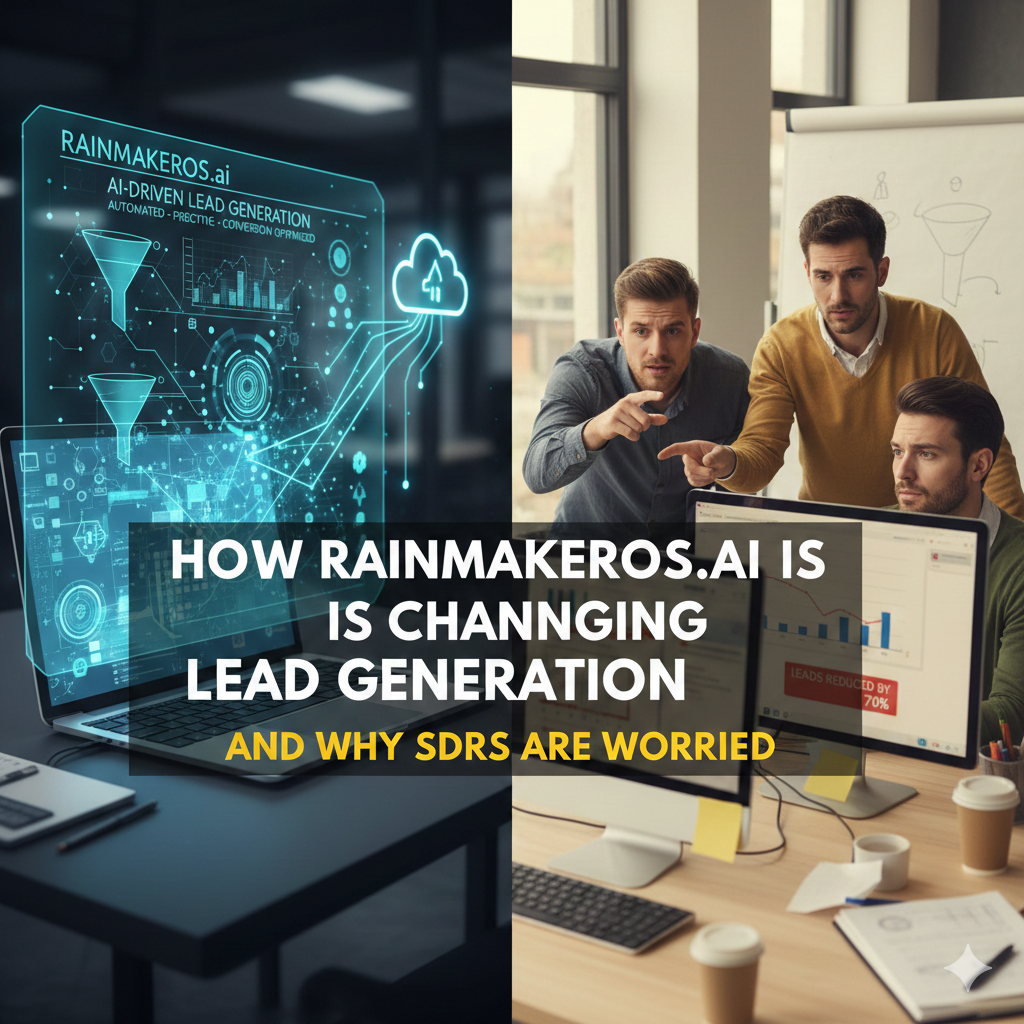
Then my buddy Jake called me up. He runs sales at a competitor, yeah, we still grab beers and compare notes-don’t tell our bosses. He mentioned this thing called RainmakerOS.ai and said it had basically replaced half his SDR team.
What Is This Thing, Actually?
RainmakerOS.ai isn’t like the other sales automation garbage you’ve probably tried. It’s one of those AI revenue automation services that actually delivers on its promises. You know the ones-they promise the world, you set them up, they blast out terrible generic emails, prospects mark you as spam, and you’re back to square one.
Then it writes outreach that doesn’t sound like a robot. It uses these GPT agents’ fancy AI language models to analyze each prospect’s specific situation and craft messages that reference real, concrete details. Not, I saw you’re in the SaaS industry, generic nonsense. More like Congrats on the Series B and the Chicago office opening-seems like you’re scaling fast, which usually means lead gen becomes a nightmare.
It runs all this across multiple channels at once. Email, LinkedIn,and even phone if you set it up that way. The platform they call Revenue Sage intelligence figures out which channel each prospect prefers based on response patterns.
And the follow-up? Never stops. Never forgets. Never gets busy with other stuff and lets a hot prospect go cold.
The Parts That Actually Impressed Me
Finding People Who Might Actually Buy
RainmakerOS.ai lead generation does this differently. It’s monitoring data constantly-company databases, news sources, social media, website changes. When something changes that matters new VP of Sales is hired, the company announces expansion, they post a job for a role that suggests they need your solution, the system catches it.
Writing Outreach That Doesn’t Make People Cringe
The AI approach is different because it pulls from way more data sources. Recent LinkedIn posts. Company blog articles. Press releases. Job listings. Technology stack changes. All the digital breadcrumbs a company leaves indicate what they’re working on and what problems they might have.
So instead of that generic garbage, prospects get something like: Saw you guys just opened a Dallas office and posted for three Account Execs there-sounds like you’re scaling the team pretty aggressively. Most companies hit lead gen bottlenecks around this stage, where the existing process can’t keep up with new rep demand…
Is it perfect? No. But it’s way better than what most SDRs send, and the response rates prove it. Companies using this typically see 40-60% higher response rates than manual outreach.
Actually Following Up Consistently
This is where humans fail hardest. Following up is boring. It’s tedious. It feels pushy. So SDRs do it inconsistently or not at all.
I used to review my team’s activity logs. Maybe half the prospects got a second touchpoint. Maybe a quarter got a third. After that? Almost nothing. We were leaving money on the table constantly because following up felt uncomfortable.
RainmakerOS.ai doesn’t have feelings about it. It just does it. Every time. At the right intervals. With messages that add value instead of just saying, following up on my previous email, like some desperate door-to-door salesperson.
And here’s what I didn’t expect: each follow-up is actually different and useful. It might share a relevant case study. Reference a new pain point. Offer a different resource. The system tracks where each prospect is in their journey and adjusts accordingly.
Hundreds of prospects get this treatment simultaneously without anyone falling through the cracks.
What This Did to Our Numbers
Okay, let’s talk ROI because that’s what matters.
We Cut Costs By About 75%
I had a team of four SDRs. Salaries, benefits, tools, training, office space-all in, we were spending maybe $320K annually. And that’s being conservative.
One RainmakerOS.ai subscription replaced three of them. We kept one SDR to handle edge cases and provide feedback to improve the AI, but 75% of the workload shifted to the platform.
Total cost for the platform? About $80K annually. The math is stupid simple. We’re talking $240K in savings while generating more pipeline than before.
Pipeline Generation Went Up, Not Down
This was the part that shocked me. I expected maybe we’d maintain our pipeline numbers at a lower cost. That would’ve been fine.
Instead, the pipeline went up by about 2.5x within the first quarter. Why? Because AI lead generation automation can work on way more prospects simultaneously than humans can. My SDRs were each managing maybe 80-100 active prospects. The AI manages thousands.
Plus, it never sleeps. Prospects in different time zones? Getting reached at optimal times for them, not just 9-5 Eastern.
We Actually Know What Works Now
Before, our reporting was a mess. SDRs would log some activities, forget others. The data was incomplete. We’d make decisions based on gut feel more than actual metrics.
Now everything gets tracked automatically. I can see exactly which subject lines get opened. Which message variations get responses? Which industries engage most? What time of day works best for different segments?
How We Actually Implemented This
Whether you’re exploring AI workflow automation for small businesses or enterprise-level operations, implementation is key. I worked with a fractional CAIO Chief AI Officer, basically a consultant who knows this stuff inside and out, to get it right. Here’s what that looked like:
First Two Weeks: Getting Set Up
We documented our ideal customer profile way more precisely than we’d ever done before. Not just firmographics but behavioral signals, tech stack, growth indicators, all of it.
Hooked RainmakerOS.ai into our Salesforce instance. Surprisingly painless-their integrations are solid.
Trained the AI on our messaging. We uploaded our best email templates, call transcripts from successful sales conversations, our pitch deck, and objection handling docs. Basically, taught them how we talk about what we do.
Weeks 3-4: Testing With a Small Segment
We didn’t just unleash this on our entire database. We picked one vertical SaaS company in the 50-200 employee range and ran a pilot.
Let the AI run its thing. Monitored every message closely. Had our remaining SDR provide feedback on lead quality. Made adjustments.
Months 2-3: Scaling Across Segments
Once we validated it worked, we expanded. More industries. More personas. More channels.
By month three, RainmakerOS.ai was handling about 80% of our outbound. The human SDR focused on complex accounts, edge cases, and providing continuous feedback to improve the AI.
What Our Sales Team Does Now
Finding the best AI automation for sales teams transformed how we operate. Now she spends 70-80% of her time talking to prospects who are actually interested. The AI filters out the noise and only routes her qualified opportunities.
She handles the complex stuff:
- Multi-stakeholder deals where you need to navigate politics
- Objections that require creative problem-solving
- Relationship building and trust development
- Custom solutions that need human judgment
The AI handles:
- Finding prospects at scale
- Initial outreach and engagement
- Consistent follow-up
- Basic qualification
- Meeting scheduling
If you’re wondering how to automate lead generation with AI without losing that human touch, RainmakerOS.ai is worth exploring. It changed our numbers, our workload, and honestly, our entire approach to outbound.